
Fitness & GymsLocal SEO
How a Chicago jiu-jitsu gym turned organic search into $1.4M+ in qualified lead value
Paid ads kept this Chicago jiu-jitsu gym’s trial calendar full, but only about 1 in 10 of those leads ever made it onto the mat. Leads from organic search showed up far more often and signed up at a stronger rate. Over 12 months, we made search the gym’s most dependable source of new members, climbing from #17 to #6 in its local market and producing more than $1.4M in qualified lead value. We did it on a closed, industry-specific website platform, working alongside the gym and the platform’s own team.
INDUSTRY Fitness and martial arts
•
TIMEFRAME 12 months
•
SCOPE Site structure, local search, content, team pages, and Google Business Profile
The results
$1.4M+
qualified lead value, 24x the investment
#6
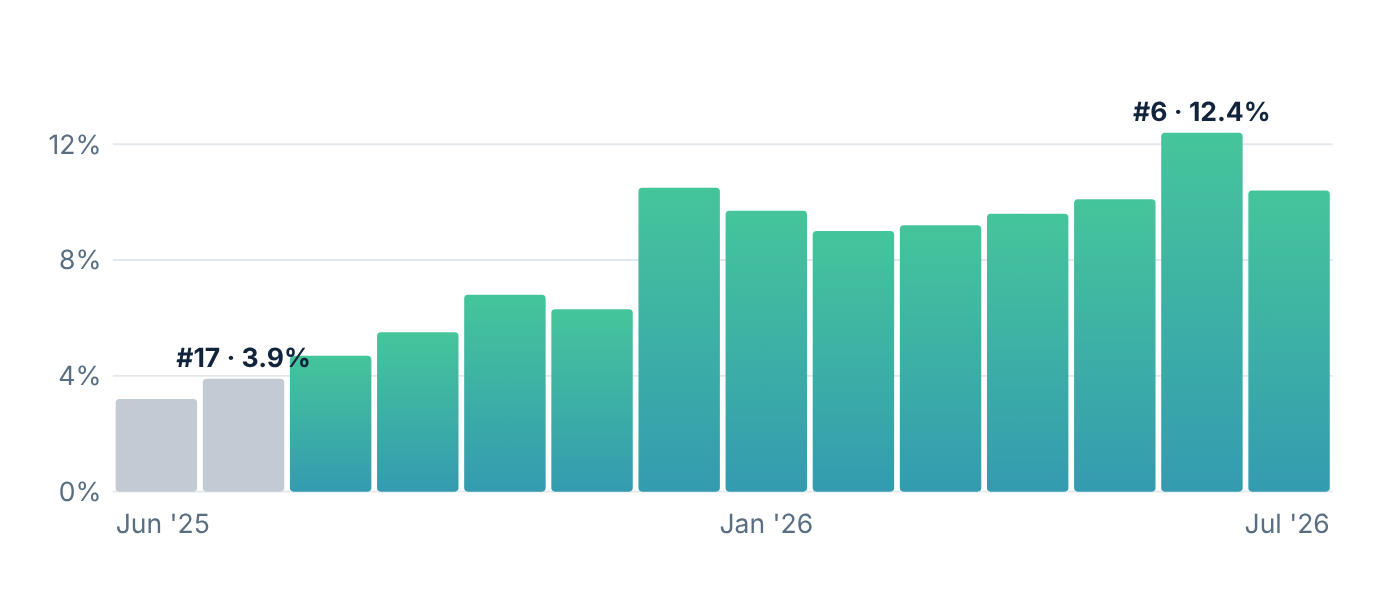
share of voice rank, from #17
185
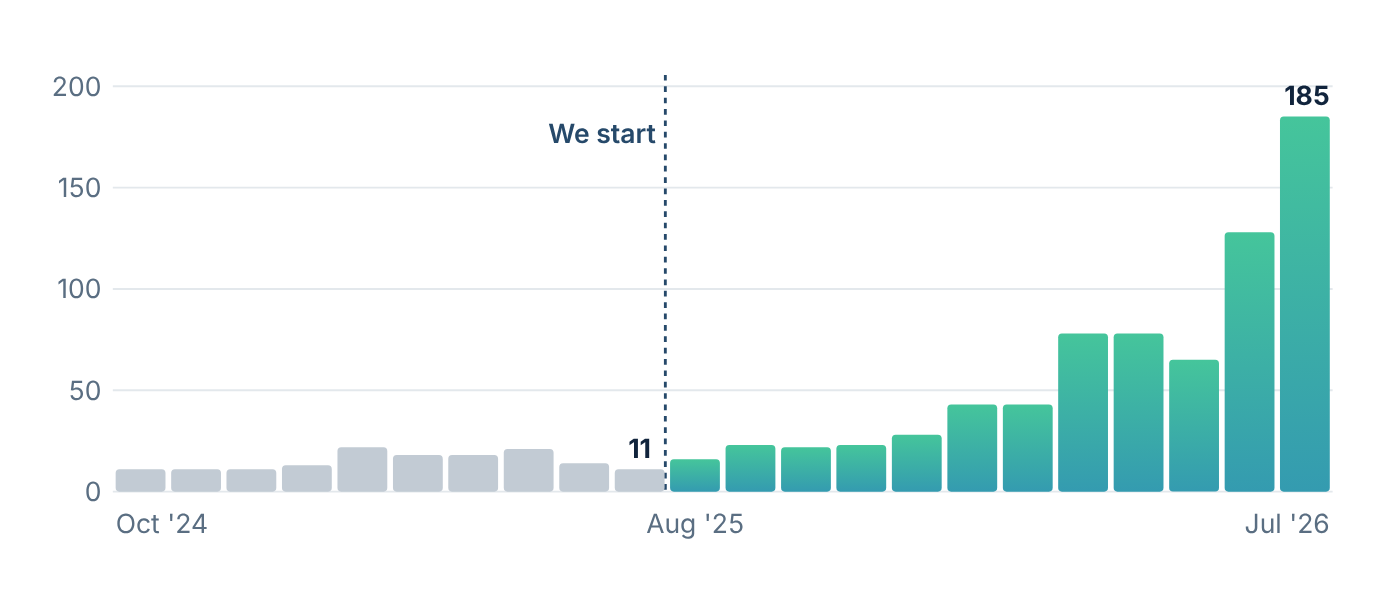
page-one keywords, from 11
+41%
search impressions
+27%
direction requests
The Challenge
The gym’s website ran on a gym-management platform that also powered its member app, class schedule, and sign-ups. For members, that was a real advantage: one system for booking, check-ins, and the schedule. For search, it was limiting. The templates were fixed, and much of what we’d normally change on a website was out of reach.
The bigger problem was the story the site told. It used “programs” and “classes” interchangeably, so a prospective member couldn’t tell what they’d actually be signing up for. The gym had three programs, the memberships people join, with classes inside them, but the site presented the programs as if they were classes. Some offerings weren’t on the site at all. The gym’s women’s classes had real search demand and plenty of activity on the mat, and no page.
Then there was the address. Google Maps had the building’s pin in the wrong spot, sending people down a side street behind the building, where there was no entrance and no signage. To help people find the door, the owner had started listing a different address in some places. That solved one problem and created another: the business information didn’t match across the web, and the inconsistency was costing the gym visibility in both search results and AI answers.
The owner was also watching acquisition costs closely. He was spending on paid social and paid search, and he wanted to know which channel brought in members at the lowest cost.
Why this was such a good fit
The owner thought about growth the same way we do: what each new member costs, and what each one is worth over time. That made every conversation practical. We could tie structure, content, and local search work directly to the numbers he cared about, and he could tell us what he was seeing at the front desk as the leads came in.
Our Approach
We started by sitting down with the owner and walking through the member experience: how people find the gym, what they sign up for, which classes they attend, and how a new member settles in. The website needed to tell that same story, so that’s where the work began.
Rebuilding the Site Around What Members Join
We restructured the main service pages around the three programs, the memberships people actually sign up for, with five classes beneath them. Programs answer “what am I joining?” Classes answer “what will I do each week?” Keeping those terms consistent across the site and the schedule meant a prospect read the same thing online that they’d experience as a member.
We also built a page for the women’s classes. It gave the gym a place to rank for searches it had been missing entirely, and a page to send the people already asking about it.
Fixing the Address at the Source
Correcting an address sounds simple. Getting Google to accept it took months of persistence. We worked to get Google to recognize the correct address and the business at that address, then updated every citation and listing we could find so the name, address, and phone number matched everywhere.
Members could finally find their way straight to the entrance, and search engines and AI tools got one consistent picture of the business. With that foundation in place, we optimized the Google Business Profile, posted to it regularly, and built out citations across the directories that matter for a local gym.
Putting the Coaches Front and Center
The gym’s biggest asset was almost invisible online. The site had a few short snippets about the owner and nothing on the rest of the staff, so someone deciding where to train had no way to see who would actually be teaching them.
And that staff is a big part of why members stay. Many of the professors are black belts with years of experience on the mat. Many are teachers outside the gym as well, several are bilingual, many have impressive academic accomplishments, and some are published authors. None of that appeared anywhere on the website.
We built a full team section with a profile for each of the eleven instructors, putting each coach’s rank, experience, and background front and center.
Individual coaches started ranking for their own names, but the bigger effect was on the brand. Named, credentialed instructors are the kind of real-world expertise search engines look for when deciding which local results to trust. They also answer the first question a nervous beginner has before booking a trial: who is going to teach me, and do they know what they’re doing? A gym with that much visible expertise earns more trust on both fronts, and that lifted the whole site.
Building Systems Behind Every Page
Every page we built came with a way to keep it current. Coach profiles run on a template, so collecting a new instructor’s information and launching their page is quick, and when two coaches stepped back, updating the team was just as easy. We also built an events system so the owner can post gym events, tag them correctly, and update them as plans change.
Time is the scarcest thing a gym owner has. We designed the workflows first and the pages second, so the site keeps working without us in the middle of every update.
Working as Part of the Team
Because the platform controlled so much of the site, we stayed in close contact with its team the whole way, working through what could change and finding routes around what couldn’t. We treat the other vendors in a client’s business as partners in the work, and that coordination is a big part of how far this site moved on a platform built mainly for running a gym.
Scaling the Content
With the structure fixed, we scaled the content around how people actually search for jiu-jitsu in Chicago and what they want to know before their first class. That steady organic search work, on top of a consistent business identity, also made the gym far easier for AI tools to understand and recommend.
The Results
Over the 12 months, organic search produced 419 qualified leads. At an average member lifetime value of $3,500, that’s more than $1.4M in qualified lead value, roughly 24 times the investment.
Those leads also behaved differently. By the owner’s own tracking, about 10% of paid leads showed up for an appointment. Organic leads booked at up to 70% in strong months, and closed at stronger rates once they showed. For an owner focused on what each new member costs, both in time and money, organic search became more profitable than paid.
The visibility gains came steadily. Keywords on Google’s first page grew from 11 to 185, and the gym’s share of voice for Chicago jiu-jitsu searches climbed from #17 to #6. A core search like “BJJ Chicago” moved from #13 to #3, and the gym took the #1 spot in the map pack for searches like “BJJ class.”
Figure 1
Search impressions rose 41% from August to August, and the gym’s average position on Google improved from 26 to 17. With the address fixed, direction requests on the Google Business Profile rose 27%, and the gym’s improved AI visibility drove real leads of its own.
Figure 2
The Throughline Was the Member Experience
Every piece of this work came back to one idea: the website should describe the gym a new member actually walks into. The programs and classes match what people join. The address takes them to the right door. The coaches they’ll train with are on the site before they arrive. Getting that right raised the quality of the leads along with the volume.
Why This One Matters to Us
We do our best work with owners who know what a new customer is worth and what the qualities of highly qualified customers are. That’s exactly how this owner ran his gym. Month by month, we could show him where organic search was beating paid on cost per member, and the website became one of the most dependable ways new members found the gym.
If you’re weighing paid against organic and wondering what each new customer really costs you, that’s a conversation we’re glad to have. A free consultation is the easiest place to start.
Every figure in this case study comes from the client’s own lead and booking records and owner-reported close rates, plus first- and third-party website performance data platforms. For privacy, we do not disclose the brand name.